
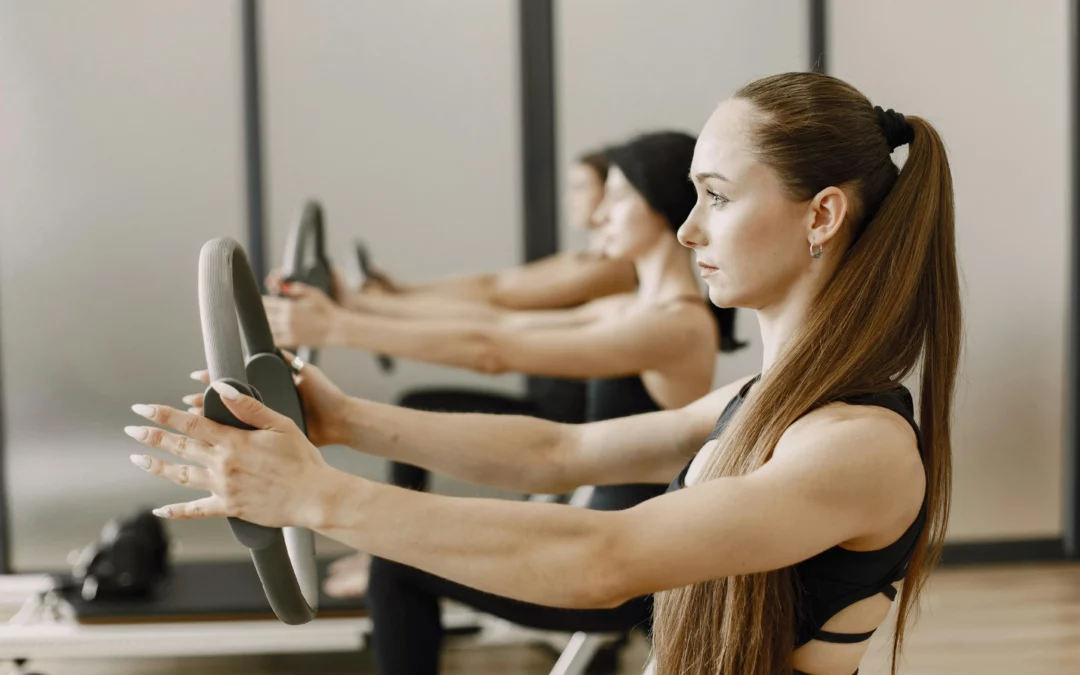
If you’ve been thinking about trying reformer Pilates but still have questions, you’re in the right place. From how often to train to what kind of results you can expect, we’ve answered the most common questions we hear at Flex & Flow, Geneva’s dedicated reformer Pilates studio.
Experience reformer Pilates for yourself. Browse the class schedule at Flex & Flow and book your first session today.
Is It Worth Doing Reformer Pilates if I Can Only Do It Once a Week?
Yes, once a week is a perfectly valid place to start, and it is far better than not moving at all. A single weekly reformer Pilates workout will still improve your body awareness, reinforce proper movement patterns, and help you build a foundation of core strength over time. You may find that as you feel the benefits, you naturally want to attend more frequently.
That said, consistency matters more than frequency. One focused, well-executed class per week will deliver more meaningful results than sporadic, higher-frequency training. At Flex & Flow, classes are kept to a maximum of eight people, so even one session a week means you receive real attention and guidance from a qualified instructor.
Is Reformer Pilates Worth It?
Reformer Pilates is worth it for most people who are looking for a low-impact, full-body workout that builds strength, improves posture, and enhances flexibility, all without placing excessive strain on the joints. The spring-resistance system on the reformer Pilates machine allows for a far greater range of targeted exercises than mat work alone, making it a more versatile and progressive training method.
Flex & Flow describes their signature group classes as dynamic, results-driven sessions that combine flowing movement with spring resistance to build lean strength, improve flexibility, sharpen coordination, and enhance core stability.
If those are outcomes you’re after, the reformer is absolutely worth your time and investment.
Research backs this up: a 2015 Cochrane Review found that Pilates exercise produced clinically meaningful improvements in pain and functional ability in adults, outcomes that are further enhanced when performed on specialised equipment.
Does Reformer Pilates Yield Faster and Better Results Than Mat Pilates?
For most people, yes, particularly when it comes to strength, rehabilitation, and body shaping. Pilates with reformer equipment adds adjustable spring resistance that challenges your muscles more precisely than mat work. The support the carriage provides also allows you to attempt exercises with correct form earlier in your training, which means you progress faster without compensating with incorrect movement.
Mat Pilates is a great complement, and both have their place in a well-rounded practice, but the reformer’s versatility makes it better suited to a wider range of goals. At Flex & Flow, sessions can incorporate a combination of Reformer, Tower, Chair, and mat work depending on individual needs, providing the best of both approaches.
When Do You Start Seeing Results from Reformer Pilates?
Joseph Pilates famously said: “In 10 sessions, you’ll feel the difference. In 20, you’ll see the difference. And in 30, you’ll have a whole new body.” This quote, cited directly by Flex & Flow, remains one of the most accurate and honest descriptions of the Pilates timeline.
In practical terms:
- Sessions 1–10: You’ll begin to feel stronger, more aware of your posture, and more in control of your movement.
- Sessions 10–20: Visible changes in muscle tone, posture, and body composition typically begin to emerge.
- Sessions 20–30+: Significant, lasting physical transformation becomes evident, both to you and others.
Attending a structured reformer Pilates class at a quality studio, like Flex & Flow, accelerates this timeline because every session is purposefully designed and properly supervised.
Can Reformer Pilates Drastically Change Your Physical Appearance?
It can, and for many clients, it does. Regular reformer Pilates practice is associated with improved muscle tone, better posture, a leaner physique, and a more confident way of moving through the world. Because the method targets the deep postural muscles and core stabilisers, not just the superficial muscles typically worked in a gym, the physical changes tend to look different: longer, more defined muscles and a naturally upright posture.
A study published in the Journal of Exercise Rehabilitation found that an eight-week Pilates programme produced significant improvements in body composition, abdominal strength, and flexibility in healthy adults.
Results will always depend on your starting point, how frequently you train, and how well your nutrition and lifestyle support your goals, but as a method, reformer Pilates is uniquely effective at reshaping how the body looks and moves.
How Many Times per Week Should I Do Reformer Pilates to Feel Its Main Benefits?
Two to three sessions per week is the sweet spot for most people who want to experience the main benefits of a reformer Pilates workout, improved strength, flexibility, posture, and core stability, within a reasonable timeframe. At this frequency, your body has enough stimulus to adapt and progress, while still having adequate recovery time between sessions.
If you’re using reformer Pilates near me searches to find a local studio and are new to the method, starting with two classes a week is a sensible approach. Flex & Flow offers a flexible class schedule and small group sizes (maximum eight people per class), making it easy to build a consistent weekly routine that fits your lifestyle.
Flex and Flow: Reformer Pilates in Genva You’ll Adore
For those with specific rehabilitation needs or performance goals, private sessions at Flex & Flow provide a fully personalised programme, allowing you to train with purpose and precision regardless of how often you attend.
Whether you’re just starting or looking to deepen your practice, Flex & Flow’s expert instructors and world-class reformer Pilates equipment are ready to support your journey.
Book your first class and take the first step toward a stronger, more balanced body.

Recent Comments